
Project management
through Action LearningE-learning based on ISO 21502 · Guided case studies · Project management simulation
For undergraduate and graduate programs, continuing education, professional development and corporate project management training.
01 — The foundation
A framework for management.
A method for learning.
Two pillars connect a method-neutral international standard with practical, action-oriented learning. The complete pathway draws on knowledge acquisition, coached project work, realistic decisions and reflection.
ISO 21502
The framework is based on the international standard ISO 21502. It provides a method-neutral reference framework for project management and can therefore be applied across different organizations, project types, and delivery approaches.
Action Learning
The instructional approach is based on Action Learning, which develops practical skills by applying knowledge to real project work.
Purpose: Bridge the gap between understanding project management principles and applying them to practical project challenges. ISO 21502 provides a common framework; Action Learning develops the ability to use that framework through project work, feedback and reflection.
Goal: Develop participants’ capability to initiate, plan, execute, control and close projects using ISO 21502-aligned practices, collaborative problem-solving and informed decisions under changing conditions.
The instructional process and intended learning outcomes
Process: Participants complete e-learning activities and guided case-study work outside class, individually and in small groups as appropriate. During weekly or otherwise scheduled 30-minute coaching sessions, groups present their work in progress, receive feedback and refine their project solutions before final submission. The computer-based project simulation provides practice in execution and control under changing conditions, with structured debriefings to compare decisions, results and lessons learned.
Intended learning outcomes: By completing the full learning pathway, participants should be able to define a project’s purpose and objectives; select and justify an approach; develop a Project Charter and Project Management Plan; identify and assess stakeholders and risks; make reasoned execution and control decisions in changing circumstances; and reflect on results to improve their decisions and practices.
02 / Learning architecture
The 4 Key
Pedagogical Ideas
Self-Paced Knowledge Building (E-Learning)
Before attempting complex tasks, learners build a shared baseline of facts, vocabulary, and standards. Instead of long lectures, this is done through short animated videos, self-checks, and mini-quizzes that let individuals learn at their own speed.
Collaborative Practice (Guided Case Study)
Learning isn't just an individual activity. Small teams of 3 to 5 people take the concepts they learned online and apply them to a concrete, realistic scenario. Together, they figure out project goals, evaluate strategies, identify risks, and draft real project plans.
Iterative Coaching & Continuous Feedback
Rather than handing in a final project blindly at the end of a term, teams participate in regular, short coaching sessions. They present their work-in-progress to an expert coach, receive constructive critique, and refine their approach multiple times.
Dynamic Simulation & Structured Reflection
Teams test their plans in a computer-based simulator that mimics real-world chaos, such as sudden budget cuts, unhelpful clients, or team conflicts. Afterward, in a debriefing session, teams compare their choices with others and reflect on what worked and what failed.
How the ideas work together
The program has three learning components—e-learning, a guided case study and project simulation—connected by coaching and reflection. Learners acquire a common foundation, apply it to a project charter and plan, and test decisions as conditions change. Feedback improves work in progress; structured debriefings turn the consequences of decisions into lessons for subsequent rounds and future projects.
The connected progression is knowing → applying → deciding → reflecting, with coaching supporting continuous improvement throughout.
Component 01 / Build knowledge
E-learning
A self-paced foundation in the processes, practices and language of project management.
This component focuses on individual knowledge acquisition through the e-learning platform. The course explains the activities involved in initiating, planning, executing, controlling, and closing a project and its phases. The content applies to different project types. It also covers predictive, iterative, incremental, and agile approaches. The relationships among organizational goals, project objectives, outcomes, benefits, and the associated organizational changes, as well as the links to program and portfolio management, are clearly explained.
The course includes around 60 short animated videos that combine spoken explanations and visual representations to support self-paced study. Exercises and quizzes reinforce the material.
Each lesson concludes with a quiz, allowing participants to monitor their learning progress continuously. Knowledge gaps become visible early rather than only at the final exam. The course concludes with an online exam.
The course is available anytime and anywhere, provided there is a stable internet connection and access to a computer, tablet, or smartphone. The languages offered are German, English, French, and Spanish.
How much time should participants plan for? One complete pass through the course takes about 10 hours. If a participant repeats the entire course to reinforce newly acquired knowledge and retakes the exercises for the exam, the total time commitment is around 20 hours. At a learning pace of 4 hours per week, completing the course twice takes about 5 weeks.
Watch / E-learning explained
E-learning resources
Access the online course and supporting reference materials.
Component 02 / Apply knowledge
Guided case study
Small teams translate concepts into project decisions, charters, plans and reasoned proposals.
The guided case study applies knowledge acquired through e-learning to pre-project work, initiation (Project Charter) and planning (Project Management Plan).
Groups of 3 to 5 participants work with a predefined overarching scenario that includes possible programs and projects. Each group identifies a particular problem or opportunity within that scenario and defines the project it will address. Two guiding questions are: “What do we want to achieve, and why?” The “why” establishes the project's purpose; the “what” defines its goal.
The groups evaluate various strategies for achieving the goal and select the most suitable one. Stakeholders, success criteria, outcomes, benefits, risks, and initial assumptions are identified to complete the Project Charter. After formalizing the Project Charter, participants begin planning the necessary work to achieve the main outcome. This includes defining sub-objectives that contribute to the main objective, gathering requirements, and establishing the delivery approach. The focus is on developing the project baseline and managing risks and communication.
Groups work outside class, in person or online, and bring drafts to scheduled 30-minute coaching sessions. They use the coach's feedback to improve subsequent versions of their work.
Watch / Guided case study explained
Case-study resources
Assignments, project scenario and example documents for guided group work.
Component 03 / Make decisions
Project simulation
Experience changing conditions, resource constraints, trade-offs and the consequences of management decisions.
The SimulTrain project management simulation gives teams a dynamic environment for practicing execution, control, replanning and project closing under changing conditions.
Unlike planning exercises, simulation reproduces the pressures of project execution. For instance, a client might fail to fulfill obligations, line managers may withdraw committed resources, or the organization's priorities may shift. Project-team motivation can change in response to participants' decisions. Complaints, changes and new risks arise; quality may fall short of expectations, and delays or budget overruns can result from participants' actions. Phone calls, voice messages and decisions under time pressure make the experience interactive.
Beyond technical trade-offs, participants practise the project manager's leadership responsibilities: motivating the team, addressing stakeholder concerns and responding to the human consequences of decisions.
During debriefing sessions between game rounds, participants compare the results of all groups and reflect, together with the coach, on areas for improvement.
Watch / Project simulation explained
Simulation resources
Briefings, guidance, project description and access to the demonstration.
Beyond individual learning
Collaboration and Coaching
In the Action Learning framework, collaboration, coaching and shared reflection connect individual e-learning, guided case studies and dynamic project simulations into an integrated learning pathway.
01 / The core role
Connecting learning through feedback
Feedback is built into the work rather than postponed until final submission. Teams present successive drafts, discuss assumptions and revise their proposals in response to coaching. This iterative cycle improves both the quality of project documents and participants' ability to respond constructively to critique.
02 / Coaching sessions
Thirty minutes of focused coaching
Small groups of 3 to 5 participants meet regularly with an expert coach during scheduled 30-minute sessions. Teams present work in progress, including project purpose, strategy, risk assessments, the project charter and the project management plan.
The coach challenges assumptions, provides constructive critique and suggests improvements. Addressing weaknesses early helps participants strengthen their work and learn to accept, discuss and apply professional feedback.
03 / Simulation debriefing
Comparing decisions and consequences
During the project simulation, coaching takes the form of structured debriefings between game rounds. Teams compare results in cost, schedule, quality and team motivation with those achieved by other groups. With the coach, they examine what worked, what failed and how to make better decisions in subsequent rounds.
04 / Collaboration and delivery
In person, remotely or in hybrid mode
Teamwork, coaching and simulation activities can take place in person, remotely or in a hybrid format. Microsoft Teams or an institution's existing digital environment can support group meetings outside class, scheduled coaching, collaborative documents and debriefings across all course components. Delivery can also be coordinated through an institution's existing Learning Management System (LMS).
Watch / Online collaboration
Course-wide systems
Course Administration.
The following administrative materials support the coordination, scheduling and evaluation of all three learning components. The linked records are sample resources rather than live enrolments.
Participant lists
Example course rosters and project-group organization.
Dates, times and place
Illustrative schedules for three sample course settings.
Course evaluation
Three demonstration evaluation forms.
Evaluation of performance
Grading Schemes.
Different course configurations use different assessed components and weightings. These examples are alternatives, not a single compulsory scheme.
| Scheme | Assessed components | Weight per component |
|---|---|---|
| A | Project Charter; online examination | 50% each |
| B | Project Charter; Project Management Plan; online examination | 1/3 each |
| C | Project Charter; Project Management Plan; online examination; project simulation | 25% each |
| D | Project Charter; Project Management Plan | 50% each |
| E | Project Management Plan; project simulation | 50% each |
These are alternative course-grading schemes, not CPPM certification criteria. CPPM has separate requirements, including completion of all three learning components and an overall performance benchmark; see CPPM certification.
Program configurations, formats and schedules
Built to fit
different calendars.
The program can be adopted in full or integrated into existing courses through individual components or selected combinations, without requiring a complete curriculum replacement. The integrated course combines e-learning, guided case study and project simulation and can be delivered across one or two semesters; tailored configurations may follow different schedules.
01 / Extended pathway
Two-semester format
2 class hours per week
First semester (Basic phase)
- E-learning: Individual, self-paced foundational study.
- Guided Case Study, Part 1: Development of the Project Charter.
- Evaluation: Online examination of foundational knowledge.
Successful completion of the first semester qualifies participants for the advanced course in the second semester.
Second semester (Advanced phase)
- Guided Case Study, Part 2: Development of the detailed Project Management Plan.
- Project Simulation: Dynamic team-based simulation of project execution, control and changing conditions.
02 / Intensive pathway
One-semester format
4 class hours per week
All components within one term
- E-learning: Foundational project management knowledge.
- Guided Case Study, Parts 1 and 2: Project Charter and Project Management Plan.
- Evaluation: Online examination.
- Project Simulation: Team-based practice in execution, control and decision-making.
The integrated course is completed within a single semester.
Optional CPPM certification: The one-semester and two-semester pathways can both lead to certification, subject to completion of all three learning components and the separate certification conditions. See CPPM eligibility and assessment requirements ↗
Class hours refer to the teaching periods defined by the delivering institution; their duration should be confirmed locally.
Optional professional credential
Evidence of
practical capability.
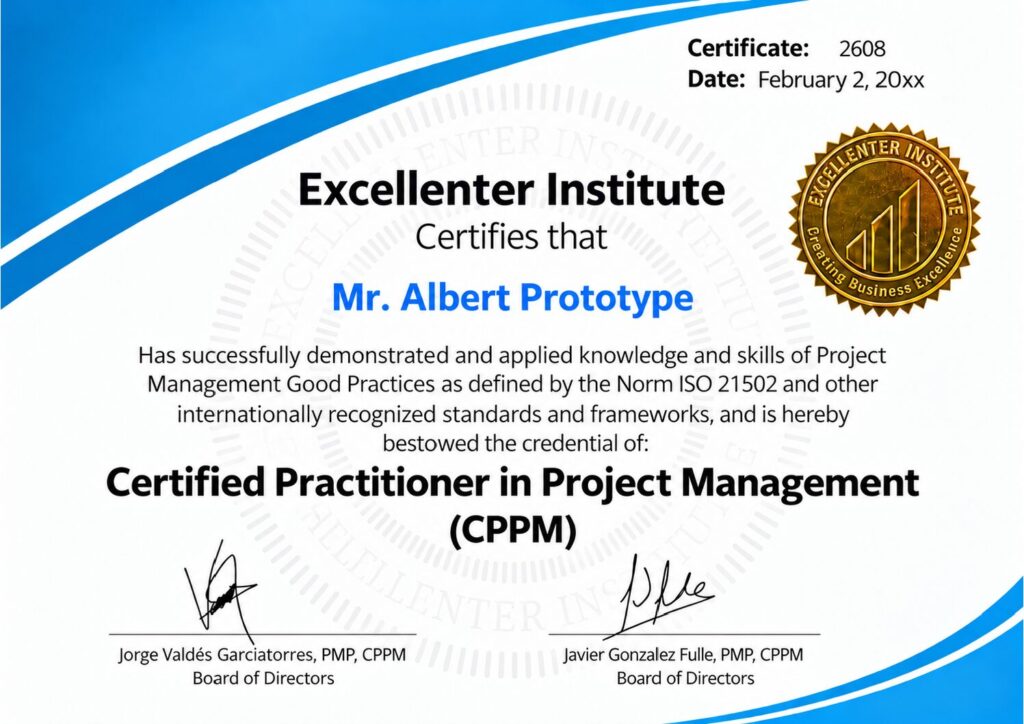
The Certified Practitioner in Project Management (CPPM) is an optional professional credential developed by the Excellenter Institute in Freiburg, Germany. Based on international project management standards, including ISO 21502, it recognizes demonstrated theoretical knowledge and practical project management capability, rather than course attendance alone.
Professional relevance
Growing demand for project management professionals
The video illustrates the growing demand for project management professionals. Action Learning develops project management capability; CPPM formally recognizes assessed knowledge and practical performance rather than attendance alone.
For individuals: A credential documenting assessed knowledge and practical competence. For organizations: A way to recognize participant achievement; the underlying training develops planning, risk management, collaboration and decision-making. Corporate group training can use a case study based on a real organizational challenge.
Watch / Demand for project management professionals
Qualification requirements
How CPPM is earned
Participants complete all three learning components, demonstrating knowledge, applied skills and practical decision-making.
E-learning and examination
Demonstrate ISO 21502-aligned project management knowledge in the online examination.
Guided case study
Evaluate strategies and risks; develop the Project Charter and Project Management Plan through collaborative work.
Project simulation
Make decisions under changing time, cost, quality, stakeholder and team conditions.
CPPM performance requirement: Completion of all three learning components and an overall assessed score of at least 80%. The pathway may be completed in one semester or across the basic and advanced semesters. Other certification conditions may apply; confirm the current conditions with the Excellenter Institute.
Get in touch
Contact
Direct contact
Find the right configuration.
Explore how individual components, selected combinations or the complete program could fit your course, curriculum or training program.
79100 Freiburg, Germany
Websites and professional profiles